
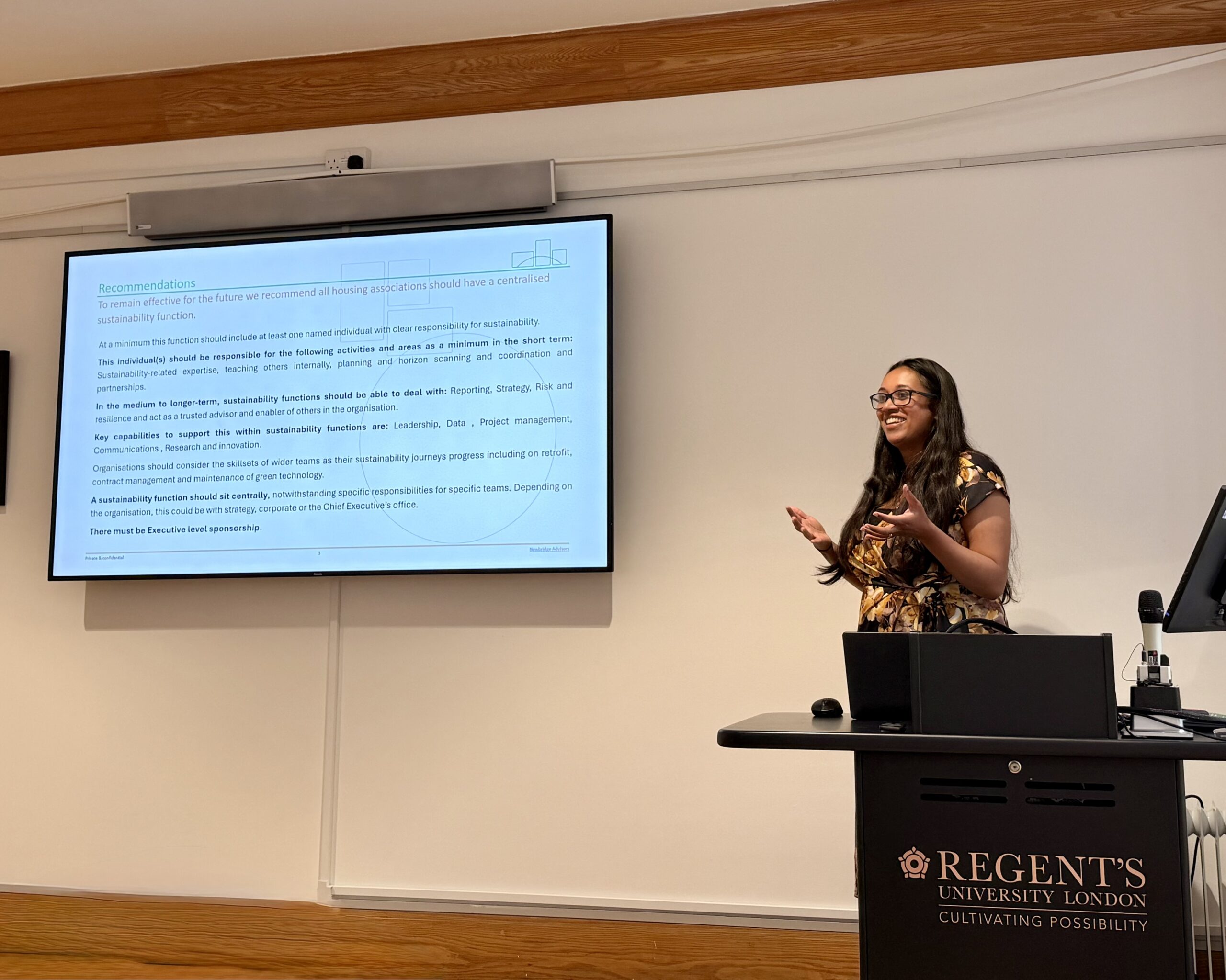

Last week, Matt Geer (Head of our London office) and I had the opportunity to attend a workshop hosted by Newbridge Advisors, following the publication of their latest report exploring how registered providers are resourcing sustainability across the UK housing sector. It was an insightful session that brought together housing associations, funders and organisations supporting the sector, creating an open discussion about what is working well, where the challenges remain and what needs to change.
The report provides a fascinating snapshot of where the housing sector is today. One of the most interesting findings was that there is no single model for success. While you might expect the largest housing associations to have the biggest sustainability teams, the research showed this is not always the case. Team sizes varied significantly regardless of organisational size, with central sustainability teams ranging from one to twenty people. In fact, teams of three and seven were the most common. With this being said, the report did state that “While the size of organisations undeniably affects absolute numbers in terms of people and budgets available for sustainability, as well as what is needed, size was otherwise not statistically significant in most of the findings.”
The research also found that 62% of housing providers have a centralised sustainability function, although where that function sits within the business differs considerably. Asset management was the most common home for sustainability teams, often giving them access to greater resources, while other housing providers placed sustainability within strategy, corporate services or elsewhere. It became clear throughout the discussions that where sustainability sits can have a real impact on the influence, support and resources available.
Another recurring theme was the diversity of sustainability roles. More than 30% of those working in sustainability also have wider responsibilities, while many sustainability activities outside central teams focus on retrofit delivery. Coordination is often achieved through cross-departmental meetings and working groups, reinforcing that sustainability is most effective when it is embedded across an organisation rather than sitting with one individual or team.
Perhaps the strongest message from both the report and the workshop was that sustainability cannot succeed without the right people, resources and leadership. Those responsible for sustainability need more than technical expertise. They should be able to educate colleagues, plan for future challenges, identify emerging opportunities and build partnerships that help drive progress.
The report recommends that sustainability should have visible executive sponsorship and be treated as a core business function rather than an additional responsibility. Housing providers also need appropriate budgets to support delivery, whether that means investing in specialist expertise, software, legal advice, communications or external consultancy. Without those resources, even the most ambitious strategies can struggle to move beyond good intentions.
One discussion that particularly resonated with me was the importance of accountability. If sustainability targets are set, they should be measured and taken as seriously as any other business objective. As the sector continues its journey towards net zero and wider environmental goals, sustainability needs to become part of everyday decision-making rather than a separate initiative.
The report concludes with practical frameworks for housing associations of varied sizes, outlining recommended team structures, responsibilities and resourcing. It provides a useful benchmark for housing providers considering whether they have the people, skills and investment needed to meet future challenges.
It was also great to see our client, Sustainability for Housing, involved throughout the event. Having written the foreword to the report, they played an active role in the workshop discussions, sharing their experience of supporting housing providers on their sustainability journeys and highlighting how the Sustainability Reporting Standard (SRS) is helping housing providers measure, demonstrate and strengthen their sustainability performance.
Overall, it was a valuable and thought-provoking event. The conversations reinforced that there is no one-size-fits-all approach, but there is a growing consensus that success depends on strong leadership, meaningful investment and collaboration across the sector. With organisations like Sustainability for Housing helping to shape that conversation, there is plenty of reason to be optimistic about the direction of travel.
Read Newbridge Advisors’ full report on sustainability resourcing within registered providers of social housing in the UK.
Written by Nishall Garala, Senior Account Manager